Supernova Explosions
Supernova & Cosmology
A Kepler Search for Supernovae
A Kepler-2 Search for Supernovae: Our White Paper and Beyond
A Kepler-2 Search for Supernovae: plus/minuses for the +/-V Observing directions
Consequences for Concurrent Ground-based Observations
Summary
Petition the K2 Team
In The News
My Work At A Glance
I am a researcher and teacher in the Astronomy Department at the University of Maryland working on a number of projects. Most recently, I have been working on Kepler data of a few hundred galaxies. With the KEGS team we discovered a number of supernovae: at least four, 5 likely and possibly more.
Other work includes binarity among stars and a recent discovery of very wide binaries. In addition, I am working on the absolute magnitude of red-clump stars, the determination of the distance to the Galactic center, the detection of solar-system analogs via SIM & Hipparcos astrometry, and a method of determining one-percent distances to external galaxies. Furthermore, I'm working on the stellar content of nearby galaxies in the GALEX data base, as well as on stars and galaxies in the Kepler field.
Before that, I was an USRA Research Scientist stationed at the United States Naval Observatory (USNO, Washington DC.). Currently, where I worked on various astrometric projects: FAME, AMEX and OBSS. Before that, I was in the Astronomy group at Rutgers University in New Brunswick (NJ). Previously I was at the University of Southampton (UK) working with Mike Merrifield on the The Milky Way. Before that I was a graduate student at Columbia University in New York. I was an undergraduate student at the University of Groningen.
Research Interests
EPOXI search for NEOs

With the EPOXI team, I am currently (fall 2010) working on a project to define a follow-up mission for NASA's EPOXI mission. One of the goals is to search for near-earth asteroids that are normally lost in the Sun's glare, but which are readily observable from space. UNFORTUNATELY, THIS MISSION WAS NOT SELECTED.
This is a FITS image of a recent EPOXI observation of comet 103P/Hartley 2.
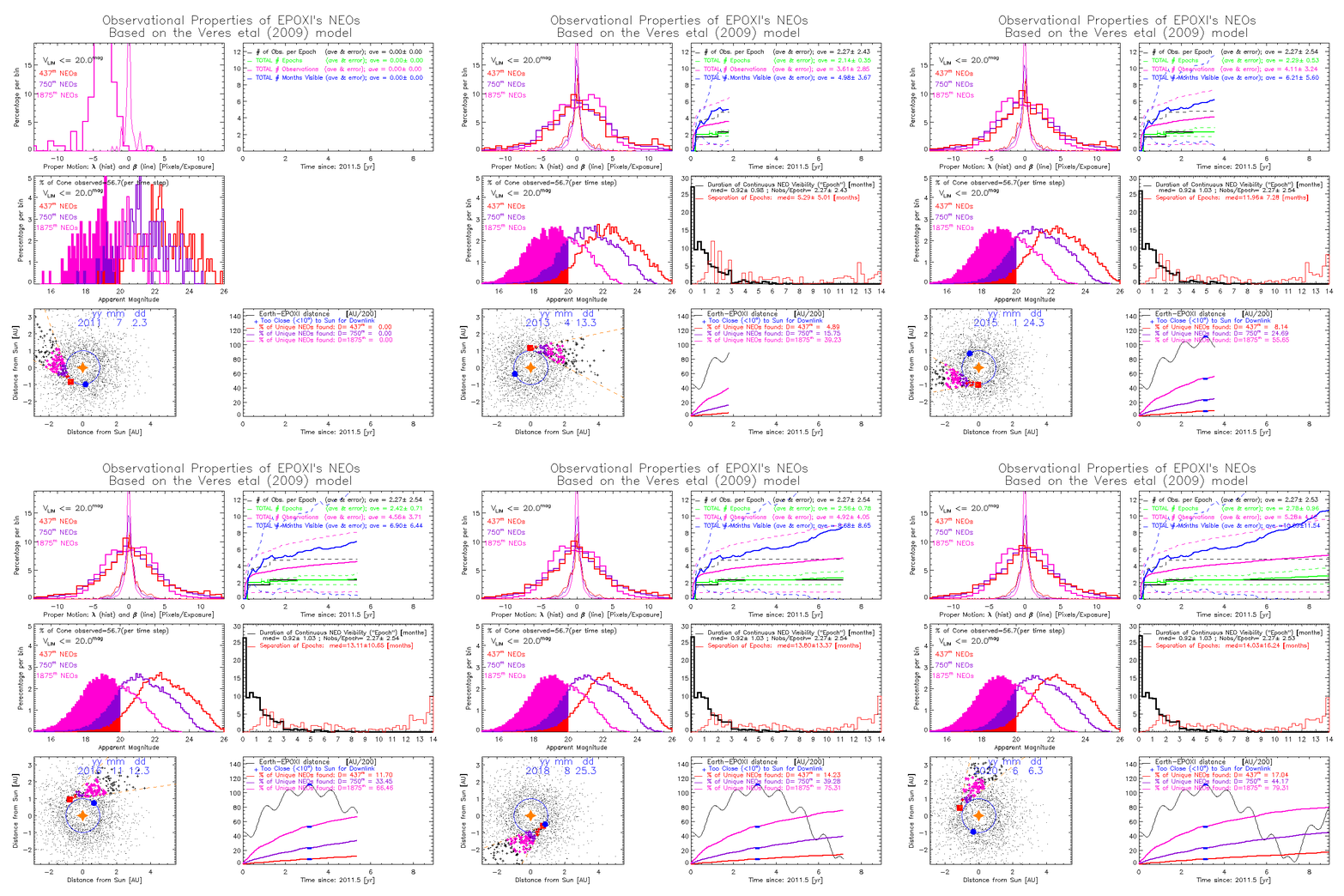
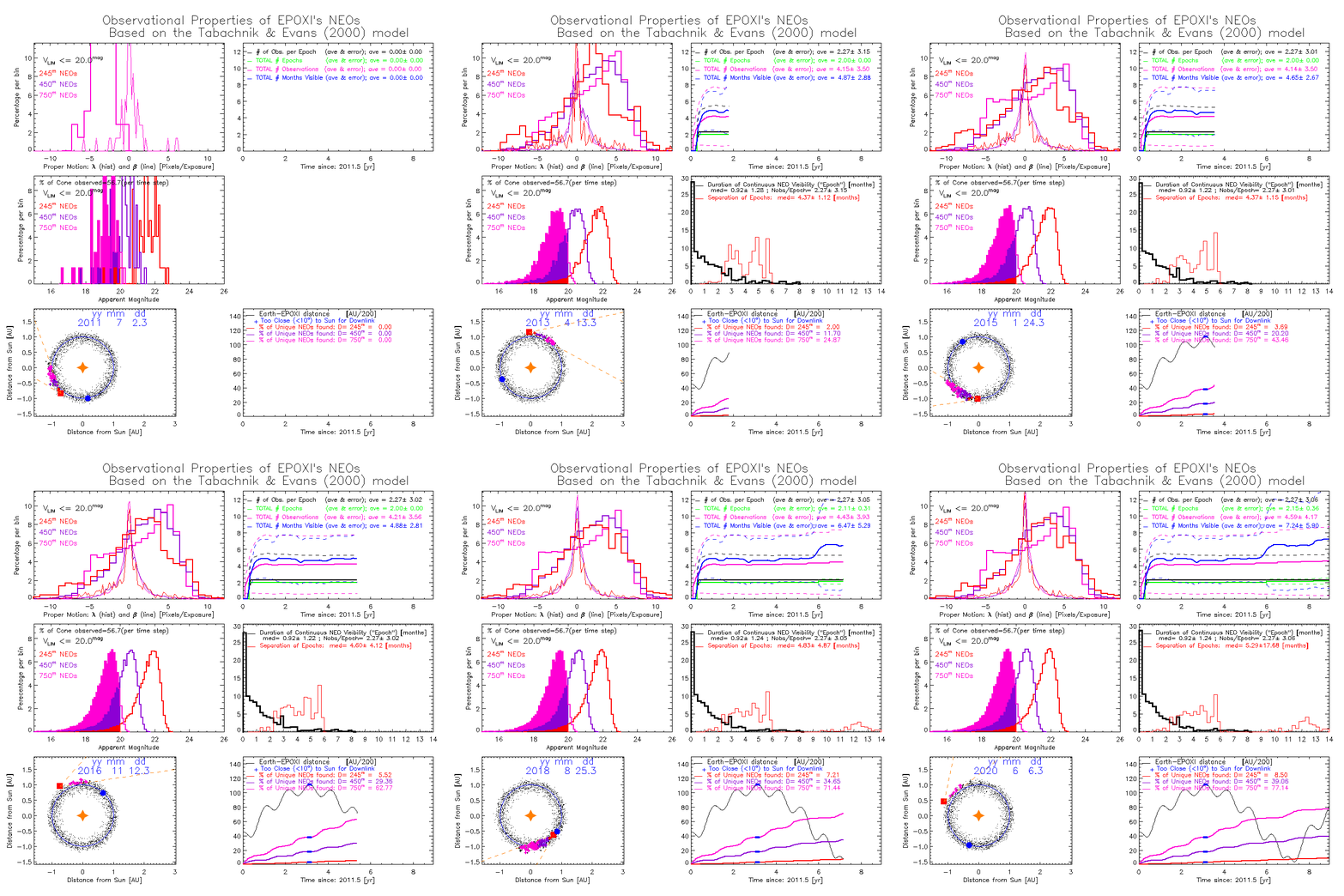
Here are two simulations. One set of results (V_LIM=20 mag) is based on the distribution of orbital elements of the larger population of Near Earth Objects by Veres et al (2009) , while the other simulation (V_LIM=20 mag) is specifically for objects in Earth's "Tadpole" and "Horseshoe" orbits (Tabachnik & Evans, 2000 and Evans and Tabachnik, 2000) .
Similar results for a fainter limiting magnitude are for Veres etal (2009) [V_LIM=21.0] and for Evans and Tabachnik (2000) [V_LIM=21.0]
For an assumed mission lifetime of 10 years, EPOXI would find roughly 1,000 (60% of all) NEO/Impactors with diameters larger than 500 m from the Veres 2009 model. This compares to discovery rate of about 75% for a 4 year survey with the PanSTARRS-1 system.
On the other hand, Tabachnik & Evans expect of order 250 objects with diameters exceeding 1,000 m on Earth's "Tadpole" and "Horseshoe" orbits. These objects are much, much, much harder to see by ground-based observatories because objects on these type of orbits can stay away from Earth for 100s to 1000s of years, even though their orbital elements are very similar to those of our pale blue dot. Because EPOXI will look at every part of Earth's orbit in about 7 years, and because these objects get pretty close to EPOXI, the detection rate for the "Tadshoes" is essentially ONE HUNDRED PERCENT.
Very Wide Binaries
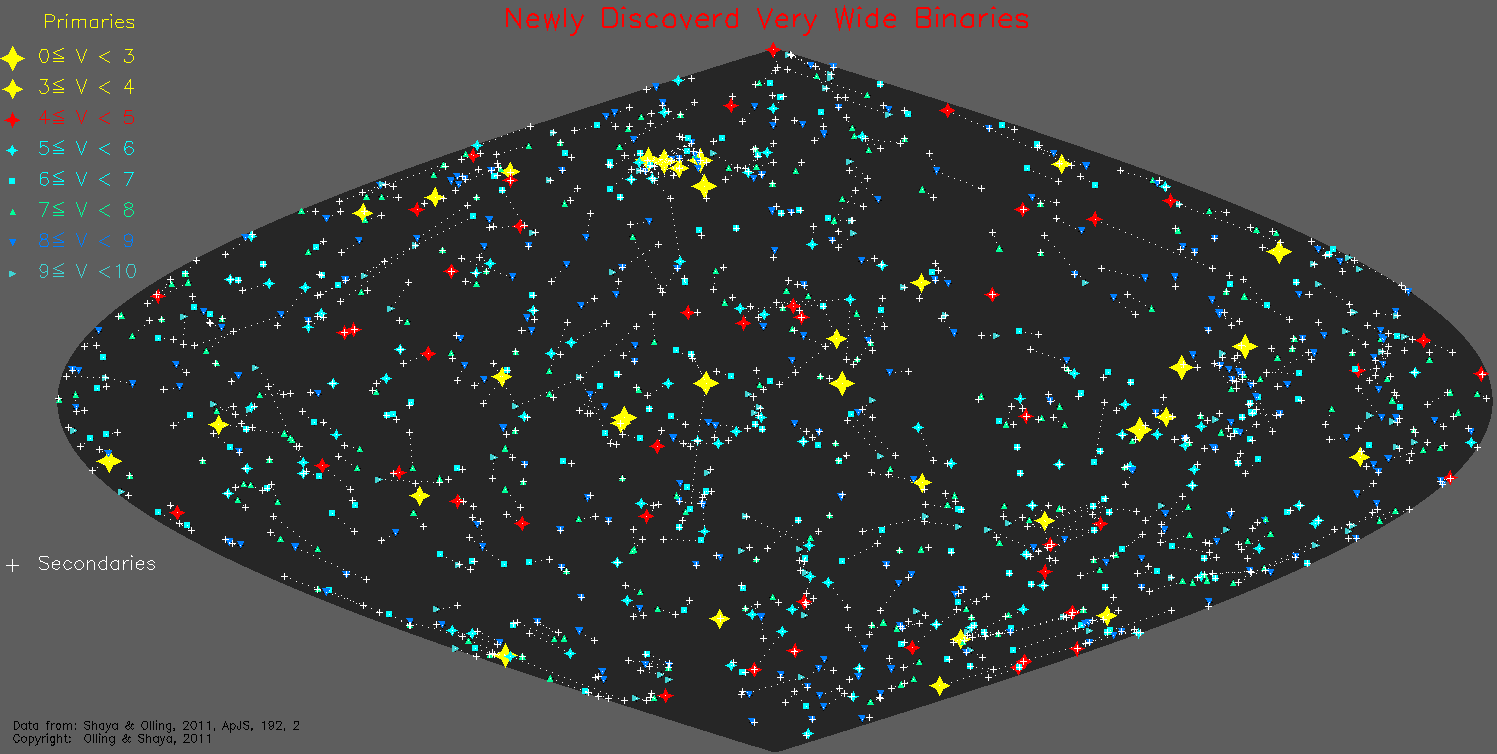
After many years of on/off work on new, wide binaries in the solar neighborhood, we recently completed a pretty stunning piece of work. We discovered new binaries, or former binaries at heretofore unheard-of separations: up to 10 parsec apart or 25 degrees. Our method is designed to look for the very widest, least bound, binary stars, and we have found about 840 probable candidates that fit that bill. These very wide systems are thought to have formed during the dissolution phase of low-mass star clusters. There future (survival as a pair) is determined by interactions with the tidal field of the galaxy, close encounters with stars and maybe even dark matter clumps/MACHOs.
Astrometry from Space
The former NASA Space Interferometry Mission (recommended by two previous Decadal Committees, but relegated to 11 derogatory lines in a footnote on page 7-9 by the 2010 group) WOULD HAVE REVOLUTIONIZED THE SCIENCE OF ASTRONOMY. SIM will be able to measure angular sizes to an accuracy of about 4 micro arcsecond. To put that in perspective, the continental United States of America subtends an angle of 4 micro arcsecond at a distance of about 7.6 parsec (~25 light-years =~ 230,000,000,000,000,000 meters).
For example, if SIM-Lite were to look at a Solar System Analog located 10 parsec away, it would be able to detect the "reflex motion" that the Earth-twin imparts on that distant sun. As we know from introductory/high-school physics classes: "action equals minus re-action." That is to say, The Sun pulls as strongly on the Earth as vice versa. However, because the Earth is so much lighter than the Sun (about 333,000 times lighter), the Sun can much more easily "push the Earth around" (accelerate) than the other way around. The net effect is that while the Earth moves in an orbit with size of 150 million km (93 million miles), it makes the Sun move in an orbit 333,000 times smaller. Doing that calculation (93,000,000 over 333,000), we find that tiny Earth pulls mighty Sun around by 450 km (280 miles): roughly the distance between Washington DC and New York NY.
It is indeed truly amazing that SIM-Lite would have detected such small motions over interstellar distances.
What should have been of particular interest to cosmologists (7% of AAS members) is the ability of stellar astronomers (almost 25% of AAS members) to reconstruct quite accurately the formation history of the Milky Way (a somewhat representative galaxy), with the data from the Gaia mission. To determine the ages of the oldest stars in the Milky Way at the percent level requires SIM-like astrometric accuracy, but this research is now postponed to an indefinite future (>20 years).
I am also interested in the dynamics of the
Milky Way. SIM can also be used to measure distances (or better,
Rotational Parallaxes) to nearby spiral galaxies. This will
provide a direct calibration of the Tully-Fisher relation, and hence
an accurate handle on distances
throughout the entire universe. In fact one could use SIM proper
motions to determine the
rotation curves of these galaxies.
To read about some other things I have been working on lately, please check this out.
I've put a couple of files on-line that are also available via the GAIA website: Composition, Formation & Evolution of the Galaxy. Note that this work describes an older version of GAIA, with roughly 2-3 times better performance.
The Current GAIA (#3) is summarized in this compilation of one-page/topic descriptions.
I submitted three White Papers to the Extra-Solar Planet Task Force. Two of these are on-line.
The first one is on how to use a space mission with a Hipparcos- or FAME-like scanning pattern to detect 10,000 transiting extra-solar planets:
"We propose a MIDEX-class space mission with the goal to find and characterize roughly 10,000 transiting planets. When transits occur, a much more detailed characterization of the planet is possible and so a large data base of transiting planets will provide planets with a large range in periods and radii for follow-up studies. Our survey will be all-sky and focused on stars brighter than V=14.8. Down to V=12, LEAVITT will be able to detect Neptune-sized objects. Because of it's high cadence, LEAVITT is about 100 times more sensitive at detecting transits than GAIA, while it will find more than 20 times as many transits as KEPLER. LEAVITT has multi-band photometric capability implemented via a low-resolution dispersive element which can obtain 0.2% (2 mmag) photometry down to V=14.8. LEAVITT's high multi-band photometric accuracy reduces the number of false-positives significantly."
The second one is on detection Solar System Analogs (SOSAs) by employing SIM-based data in conjunction with HIPPARCOS astrometry:
"The astrometric signature imposed by a planet on its primary increases substantially towards longer periods (proportional to P^2/3), so that long-period planets can be more easily detected, in principle. For example, a one Solar-mass (M_Sun) star would be pulled by roughly 1 mas by a one Jupiter-mass (M_J) planet with a period of one-hundred years at a distance of 20 pc. Such position accuracies can now be obtained with both ground-based and space-based telescopes. The difficulty was that it often takes many decades before a detectable position shift will occur. However, by the time the next generation of astrometric missions such as SIM will be taking data, several decades will have past since the first astrometric mission, HIPPARCOS. Here we propose to use a new astrometric method that employs a future, highly accurate SIM Quick-Look survey and HIPPARCOS data taken twenty years prior. Using position errors for SIM of 4 muas, this method enables the detection and characterization of Solar-system analogs with periods up to 240 (500) years for 1 (10) M_J companions. Because many tens of thousands nearby stars can be surveyed this way for a modest expenditure of SIM time and SOSAs may be quite abundant, we expect to find many hundreds of extra-solar planets with long-period orbits. Such a data set would nicely complement the short-period systems found by the radial-velocity method. Brown dwarfs and low-mass stellar companions can be found and characterized if their periods are shorter than about 500 years. This data set will provide invaluable constraints on models of planet formation, as well as a database for systems where the location of the giant planets allow for the formation of low-mass planets in the habitable zone."
I just finished a long version of what I thought would be one of my White Papers for the upcoming Decadal Review. Instead, in collaboration with several colleagues, we combined into a single White Paper the desire to promote the extreme utility of both NASA's proposed SIM-Lite Astrometric Observatory, and ESA's GAIA in the areas of Galactic archeology and the final establishment of the Galactic and extra-galactic distance scales, and the ADS version.
I am presenting some of my work on astrometry, galaxy-formation
and cosmology via professional colloquia: here is an abstract and a set of detailed slides.
In my talk I will discuss how astrometry, galaxy formation and
cosmology (among others) are intimately linked through the detailed
studies of nearby stars (A) and nearby galaxies (B). Such linking
will be made possible through the highly-accurate astrometric and
photometric data produced by GAIA, the
SIM-Lite
Astrometric Observatory and OBSS (the Origins Billion Star
Survey) .
A) Possibly the most important piece of information that these
missions will nail down stellar ages at the 1% level from the
observed absolute luminosity (distance/parallax) and their masses,
radii and composition: need eclipsing binaries.
-- GAIA can get 1% distances for ~ 190,000 (12,000) [300]
eclipsing binaries in the thin disk (thick disk) [halo] with
accuracies of ~100 Myr per star.
-- SIM-Lite should do the rare special cases such as old Uranium stars.
===> This kind of data will yield the detailed STAR FORMATION
HISTORY and METALLICITY EVOLUTION of the larger Solar
neighborhood (<~ 600 pc) plus the 3D kinematics
===> VERY IMPORTANT BENCHMARK for galaxy formation theories
B) At the extra-galactic front, both GAIA and the SIM-Lite Astrometric
Observatory can determine one-percent distances to our closest
neighbors via the method of "Rotational Parallaxes" [Olling,
2007, MNRAS, 378, 1385]. GAIA can do the LMC, SIM is required
for M31 and M33.
I will describe in some detail the RP technique and show why it
is expected to more robust than all other proposed
methods. However, the RP method can sample only the 1st Mpc or
so: other (geometric) methods such as derived by the "Water
Maser Cosmology Project" are essential to bridge the gap between
accurate distances and an accurate H_0.
I will discuss the utility of 1% knowledge of H_0 for cosmology
and dark energy research.
We all though that before SIM flies, we would have a lot of fun with FAME, which was to be launched in 2004. Unfortunately, FAME was the first victim of NASA's priority setting mechanism. This is particularly unfortunate because the FAME data would have provided an excellent data set which, combined with GAIA or SIM, would have enabled the detection of extra-solar planetary systems much like our own Solar system.
Other astrometry projects such as DIVA and AMEX did not make it much past the proposal stage. OBSS (the Origins Billion Star Survey) was one of nine selected proposals from a field of 26 submissions for detailed feasibility studies for the next generation of space probes in its Astronomical Search for Origins Program in 2004. Contrary to other astrometry missions, OBSS is designed to combine wide-field imager with a rapid re-pointing technologies to obtain a high-cadence observatory. OBSS will work much like a ground-based astrometry program, where the absolute astrometry will be obtained by direct linkage to an extra-galactic reference frame. Because OBSS is a pointed instrument, it can in principle obtain very long integration times (and hence very good accuracy) for selected sources. GAIA is expected to yield accurate astrometry, photometry and radial velocities for one billion stars, and will revolutionize our understanding of astrophysics: from brown dwarfs to cosmology. Of course, astrometry was re-invented by Hipparcos, the first satellite dedicated to astrometry.
FAME, AMEX and OBSS projects at the US Naval Observatory.
My Contributions to (Space) Astrometry: Latest
- AAS Winter Meeting, Jan 2009:
- Solar System Analogs (poster)
- 1% Luminosity Independent Distances (poster)
- SIM/GAIA Meeting in London, Nov. 2008:
- Solar System Analogs (talk)
- Astrometry: Historical Data, GAIA & SIM (talk)
- Rotational Parallaxes (talk)
- Optimal SIM/GAIA Collaboration (thoughts)
- "Connecting Stars (their planets), Galaxies and the Universe in the
Decade of Astrometry"
(GMU, April 2009)
- "Astrometric & Photometric Detection &
Characterization of (massive) Extrasolar Giant Planets"
(PALS@UMd, March 2009)
- "Astrometric & Photometric Detection &
Characterization of (massive) Extrasolar Giant Planets"
(GSFC, Jan. 2009)
- "Astrometry, Precision Astrophysics, H0 & (some) Cosmology:
A Connection between Stars, Galaxies and the Universe"
(NRAO, Oct. 2007)
FOR THE ASTRO 2010 DECADAL REPORT:
- "micro-arcsec Astrometry:Connecting Stars, Galaxies and the Universe"
(Last Version, Jan 2009;
and the ADS version)
FOR THE EXTRA-SOLAR PLANET TASK FORCE (2007):
- "LEAVITT: A possible MIDEX mission to characterize 10,000
transiting planets" (2007;
and the ADS version)
- "Finding Solar System Analogs With SIM and HIPPARCOS"
(2007;
and the ADS version)
- "Hunting for Earth-Mass Exo-Planets with the Dispersed Fourier
Transform Spectrometer"
(2007; PI=Hajian)
Also check out our ApJ paper:
Initial Results from the USNO Dispersed Fourier Transform Spectrograph
My Contributions to (Space) Astrometry @ USNO
Between September 2000 and October 2005, I have been working on
the
During this period, I worked on many
aspects of astrometric and photometric surveys of the Galaxy and the
Local Group. Most (25) of the resulting technical memoranda are listed
below. None of these memos have been published.
Black Hole Results from STIS
Presented at the ``Black Holes in Binaries and Galactic Nuclei'' workshop, ESO, Sept. 6-9, 1999
R. Olling, C. Joseph, D. Merritt (Rutgers University),
M. Valluri (University of Chicago)
The Space Telescope Imaging Spectrograph (STIS) has obtained 0.1-0.2'' resolution spectra from the nuclei of about 15 nearby galaxies in a search for supermassive black holes. This talk concentrates on the data reduction process and the difficulties which have to be overcome to obtain reliable kinematic measurements from STIS observations. In particular, the under-sampling of the spatial part of the point-spread function and the presence of a large numbers of cosmic rays in the images complicate the analysis significantly. Our analysis is based on standard STIS-pipeline software (the IDL version of the CALSTIS package). We pay particular attention to the effects of regridding under-sampled images containing galaxies (with power-law cores) as well the point-like artifacts that typically contain ~90% of the total counts (cosmic-ray hits).
We also present the nuclear kinematics for several galaxies for
which Rutgers astronomers are lead investigators, including M32, M87,
NGC 2842. In M32 we reproduce the van der Marel et al. (1998) FOS
results but with approximately 7 times higher velocity resolution,
and 2 times higher spatial resolution. In NGC2841 we obtain a clear
signature in the stellar motions of a black hole with mass of several
tens of million solar masses, the first black hole detection in this
galaxy. In M87 we measure the stellar velocity dispersion at a radius
of ~0.3'', a factor of ~2 higher spatial resolution than existing,
ground-based data. In each of these galaxies, the STIS stellar data
extend well within R_g, the radius of gravitational influence of the
black hole, making the interpretation of the black hole mass
essentially independent of the stellar anisotropy.
Flattened Dark Matter Halos
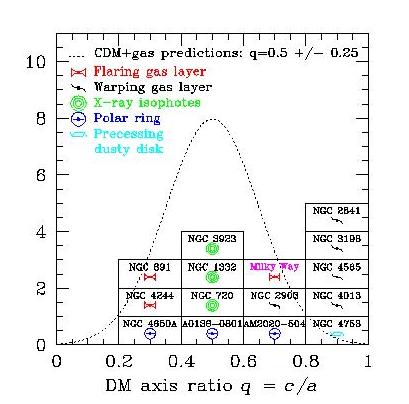
Currently I am trying to determine the shape of dark matter
halos surrounding spiral galaxies. This is done by constructing
(almost) self-consistent mass models of spiral galaxies which have the
shape of the halo as a free parameter. Galaxies with flat halos have
thinner gas layers than galaxies with a round halo, for a given
rotation curve and gaseous velocity dispersion ( 1995,
AJ, 110, 591-612 ). Observationally, sensitive high resolution HI
spectral line observations yield the rotation curve, the thickness and
velocity dispersion of the gas layer ( 1996,
AJ, 112,457-480 ). Thus, these observations allow for the
determination of the shape of dark matter halos of spiral galaxies
(with extended HI envelopes). The first results, for the edge-on Scd
galaxy NGC 4244 ( 1996,
AJ, 112, 481-490 ), indicate that dark halos might be highly
flattened (shortest-to-longest axis ratio ~0.2, or E5-E9 shape, for
NGC 4244). Details about mass modeling of spiral galaxies and
determining the thickness of the HI layer can be found in my thesis
which is available via ftp.
Flaring Gas Layers and Rotation Curves
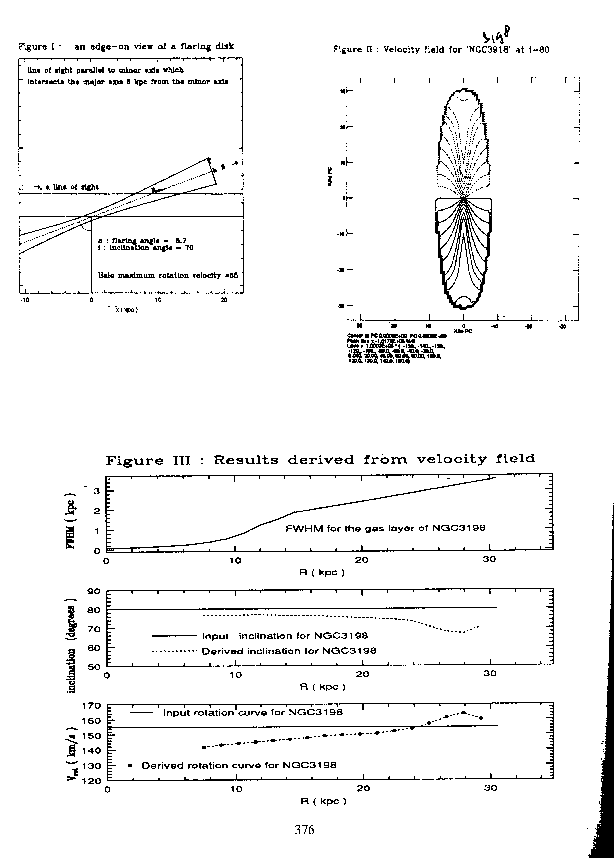
There are also dynamical effects of a flaring gas layer as illustrated by the figures on the left. The top panel shows the geometry of a line-of-sight that passes through an arbitrary point in the galaxy. Before the line-of-sight intersects the midplane, it passes through gas closer to the major axis (smaller angle theta) but at greater z-heights above the plane. Because this gas is closer to the major axis, it has a larger value of the "cos(theta)" projection factor: that is to say, larger apparent radial velocity. Gas beyond the midplane arises from larger theta-angles and has hence smaller "cos(theta)" values. Thus, along a given line of sight, there is a radial velocity gradient induced by the flaring, with larger velocities closer to the major axis. In the limiting but unrealistic case that the HI densities would be the same all along the line of sight, there would not be a net velocity bias. However there are likely to be several gradients present: 1) vertical density gradient, 2) radial surface-density gradient, 3) radial rotation-curve gradient, and 4) radial velocity dispersion gradient (as well as possible vertical gradients of #3 and #4). However, the strongest gradient is due to the finite thickness of the disk (#1), and as long as this gradient dominates, the vertical structure of the disk will set the effects on the velocity field. Analytical calculations show that: 1) in all cases the peak intensity is shifted towards higher velocity [i.e., smaller "cos(theta)" factors], 2) thicker gas layers cause a larger shift, 3) steep radial density profiles increase the effects, and 4) the effect decreases towards smaller inclinations.
To illustrate this effect, we computed a model spectral-line data cube and a corresponding velocity field with parameters similar to the fitted parameters for NGC 3198 (Begeman 1987). However, we increased the inclination to 80 degrees and we used a completely flat rotation curve. The computed velocity field (top-right panel of the accompanying figure) shows an outward curving of the iso-velocity contours, which is indicative of a rising rotation curve. Since our input was a flat rotation curve, the difference can be fully attributed to the effects of the flaring of the gas layer. We also performed fits (employing ROTCUR) to the resulting velocity field and we display the results in the bottom panel of the accompanying figure. Here we see that the inferred inclination is smaller than the input value, and that the flat input rotation curve is transformed into an apparently gently rising rotation curve ( Olling & van Gorkom, 1993). Click here for pfdf file
Since these effects are largest in the outermost regions of galaxies
(where the column-density gradients are largest) and for low-mass
galaxies (with thick gas layers), the current interpretation of
rotation curves as derived from the velocity fields in terms of the
amount and shape of dark matter will be affected to a currently
unknown degree.
The Milky Way
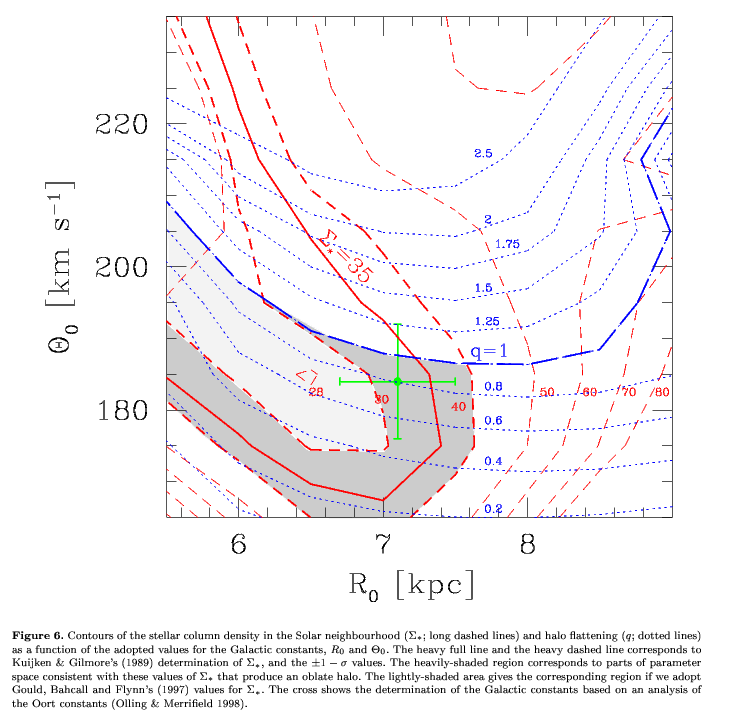 Size, Mass and Shape of the Milky Way Mike Merrifield and I
are using a similar technique for the Milky Way Galaxy. We combine
this method with constraints arising from the total mass within 1.1
kpc from the plane of the Galaxy. We find that the dark halo of the
Milky Way is rather round, with shortest-to-longest axis ratio (c/a)
>~0.5 if R_0 >~7 kpc. The inferred dark matter halo flattening
depends strongly upon the distance to the Galactic center and local
rotation speed. The measurements of the thickness of the gas layer in
the outer Galaxy exclude the IAU recommended values of R_0 = 8.5 km/s
and Theta_0 = 220 km/s (assuming the IAU recommended value of 26.4
km/s/kpc for Theta_0/R_0=A-B). Using the local stellar column density
as a constraint, we find that the distance to the Galactic center is
smaller than ~7.3 kpc. Similarly, assuming that the Milky Way's Dark
Matter Halo is oblate we deduce that
Size, Mass and Shape of the Milky Way Mike Merrifield and I
are using a similar technique for the Milky Way Galaxy. We combine
this method with constraints arising from the total mass within 1.1
kpc from the plane of the Galaxy. We find that the dark halo of the
Milky Way is rather round, with shortest-to-longest axis ratio (c/a)
>~0.5 if R_0 >~7 kpc. The inferred dark matter halo flattening
depends strongly upon the distance to the Galactic center and local
rotation speed. The measurements of the thickness of the gas layer in
the outer Galaxy exclude the IAU recommended values of R_0 = 8.5 km/s
and Theta_0 = 220 km/s (assuming the IAU recommended value of 26.4
km/s/kpc for Theta_0/R_0=A-B). Using the local stellar column density
as a constraint, we find that the distance to the Galactic center is
smaller than ~7.3 kpc. Similarly, assuming that the Milky Way's Dark
Matter Halo is oblate we deduce that
Theta_0 <= 188 - 5.6*(R_0-7) +
4*(R_0-7)^2.
(Olling & Merrifield, 2000, MNRAS,
311, 361). (postscript, html (not yet available,
sorry)).
Luminous and Dark Matter in the Milky Way
We have extended the analysis above to include the effects of the (unknown) temperature of the interstellar medium. We find that the temperature gradient of the ISM in the Galaxy has to be small, so small that is can not affect the above conclusions significantly. The Milky Way's dark matter halo can be significantly flattened only if our distance to the Galactic center is smaller than ~6.8 kpc. So the dark matter in the Milky Way is probably not in the form of cold molecular hydrogen or decaying massive neutrinos as these forms of dark matter require very flattened distributions (c/a < 0.2). If we assume the IAU-recommended values for the Galactic constants, it is NOT possible to build a self-consistent Milky Way mass model, unless the plane of the Galactic dark matter halo is perpendicular to the plane of the Galactic disk. We have recently submitted these results to MNRAS. (postscript, html (not yet available, sorry))
Popular descriptions of this work can be found in various places:
the 1997 NAM press
release, the report in El Pais, or in Science
Now).
We are also re-examining the Oort constants, how they
are determined and what we can learn from them. Completely independent
from the halo flattening results, we find strong evidence that the
distance to the Galactic center and the rotation speed at the Solar
circle are smaller than commonly thought: R_0 = 7.1 +/- 0.4 kpc, and
Theta_0 = 184 +/- 8 km/s. (1998,
MNRAS 297, 943 , postscript , html (not yet available,
sorry))
 Thesis

![Veres etal (2009) [V_LIM=21.0]](Images/EPOXI_SC_NEO_Selection_Geometry_Veres_etal_2009_SA_060_100_Vlim_21.0.gif)
![Evans and Tabachnik (2000) [V_LIM=21.0]](Images/EPOXI_SC_NEO_Selection_Geometry_Tabachnik_Evans_2000_SA_060_100_Vlim_21.0.gif)
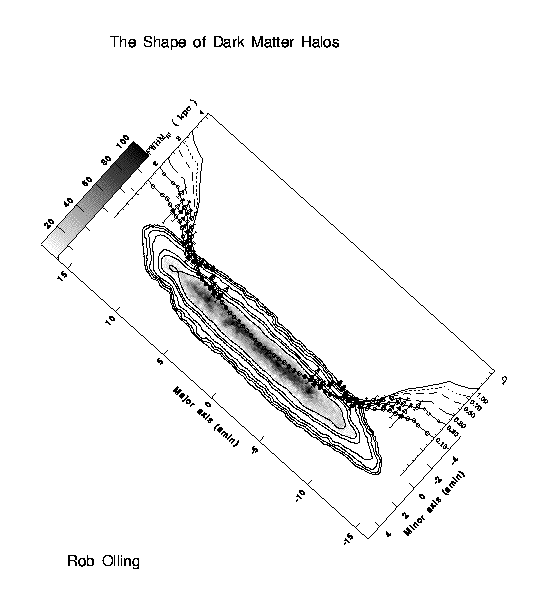
My dissertation ``The Shape of Dark
Matter Halos'' (1995), was supervised by Jacqueline
van Gorkom.
( This picture says as much as 64,724 words. )
Publications
Try this ADS
link for a list of all/most of my papers in one place.
Refereed papers are here
with a total 1,488 citations (68/paper; excluding the erratum),
and 28.1 citations/paper/co-author.
ADS also allows you to see all/most
of the 1,267 papers that refer to my work.
Google Scholar keep track of me as well.
My Literature Database
I try to keep up with the literature on a number of topics. These
days, most paper I read are stored in an “ADS
Personal Library,” with over 278 topics of interest to me,
and over 7,533 papers that I "read" (i.e., at least the abstract). I
encourage you to create such libraries yourself.
General Interests
Hiking, astronomy, Belgian and US micro-breweries, speed skating.To understand why Dutch people like ice skating, check out Siebren's pictures of Nederland onderijs. Or a collage of pictures from the 1997 Elfstedentocht.
IDL Speed Tests
My IDL speed test routine is taken from the standard IDL library, and modified to be slightly more general. Details of the test can be found here.
And the best of all is Alex
Disclaimer
This is my private home page and any views expressed here are MY
OWN and do not represent the views of my employer.
Last Modified: 5 February 2018> My current Email address is: olling (at) astro.umd.edu. Or ring me up at: (1)-202-469-2930 at work.
If you want to send me flowers, try this.