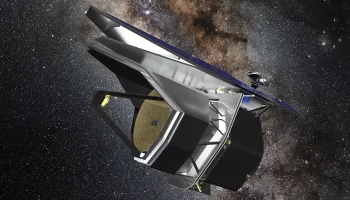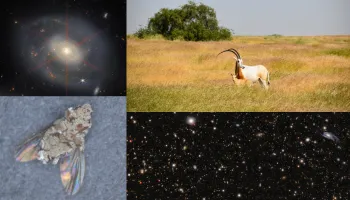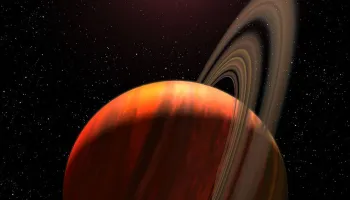
Astronomy’s Suvi Gezari works on UVEX, which will survey the entire sky in the ultraviolet and provide detailed glimpses into the universe’s most energetic explosions.
A telescope co-developed by University of Maryland Astronomy Associate Professor Suvi Gezari advanced to Phase C: Final Design and Fabrication in NASA’s selection process. The multi-institutional team led by Caltech will now move from planning to building and executing the mission.

The Ultraviolet Explorer (UVEX) is scheduled to launch by January 2031 as a NASA Astrophysics Medium-Class Explorer. With a total lifecycle cost of $590 million, the mission proposes to visualize ultraviolet radiation from the entire sky with unprecedented sensitivity. It will also zoom in on powerful explosions such as kilonovae, which follow the collision of two neutron stars, and supernovae, which occur when massive stars explode. Gezari is the mission’s dynamic universe lead, spearheading science on these transient phenomena.
“It’s really exciting for us to advance to the next stage because we've put a lot of work into this initial mission-planning phase,” Gezari said. “This new ultraviolet window into the universe will yield many discoveries and will be a huge advance in our field, especially for studying energetic explosions in the universe.”
The last NASA mission to image large swaths of the sky in the ultraviolet was the Galaxy Evolution Explorer (GALEX), which was launched in 2003 and decommissioned in 2013. Compared with its predecessor, UVEX has greater resolution and 50-times better sensitivity, empowering astronomers to test various theories of galaxy evolution and star formation.
One core area of UVEX research involves low-mass galaxies with very few metals and heavy elements. These make up the majority of galaxies in the universe but are difficult to observe through optical or infrared imaging because they are extremely faint. Researchers have only discovered about 20,000 of the 10 to 200 million low-mass galaxies predicted to exist within roughly 300 million light-years of Earth. With UVEX, the team expects to find millions more.
In addition to imaging the entire sky, UVEX will point toward specific transient sources of light, such as short-lived supernovae and kilonovae, within hours of when they’re first discovered. Using the device’s ultraviolet spectrometer, researchers can study the environment, physics and chemistry underlying these events.
“For kilonovae, early UV observations provide critical information that can distinguish between models about what’s powering the early hot emission in these violent merger events,” said Gezari. “For supernovae, they radiate brightest in the ultraviolet early on, but it doesn’t last for long—only hours to days—so a fast response is really critical.”
UVEX’s imaging will complement existing space observatories such as NASA’s Nancy Grace Roman Space Telescope, which visualizes the universe in infrared light, and the NSF-DOE Vera C. Rubin Observatory, Gezari said. Rubin is designed to visualize the universe in visible light and infrared radiation. UVEX will achieve similar sensitivity, but in the ultraviolet. Gezari is eager to see how outside scientists—who will have access to 8% of the telescope’s observing time—will use UVEX in response to discoveries with other premier instruments.
“Rubin and Roman will discover many new transient phenomena, and we will provide a critical spectroscopic capability to follow up quickly to capture the fleeting information encoded in the ultraviolet,” Gezari said. “What I’m most excited for is to provide a resource for the community to trigger targeted ultraviolet observations for various transient phenomena, from supermassive black holes ripping up stars to new classes of supernovae that we don’t yet understand.”