Kevin Rauch's Research


Most of my current/recent effort is devoted to correlator hardware and software development for several radio/infrared telescope facilities, including CARMA, GBT, RLT, and SOFIA. By training I am a theoretical astrophysicist. My basic research interests include black hole physics, (active) galactic nuclei, gravitational lensing, numerical techniques, relativistic astrophysics, and celestial mechanics/stellar dynamics. My research is theoretically oriented and usually involves substantial numerical computation.

ADS Listing for past 5 years


Revised CARMA correlator
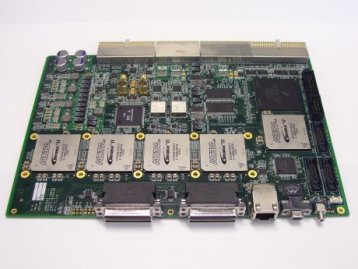
The CARMA correlator is undergoing a hardware revision, which will substantially improve its current capabilities. Each correlator band consists of a set of custom digital logic cards which digitize and cross-correlate the raw array antenna signals. I am working on embedded programming for the FPGAs on these boards (the large silver chips in the photo), which are responsible for real-time signal processing of the digitized antenna signals. I am also developing part of the higher-level data acquisition and control software.


Green Bank Zpectrometer
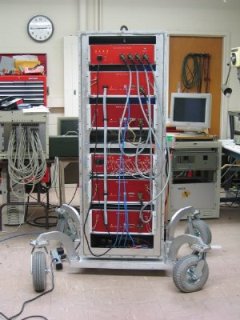
I designed and implemented the embedded firmware for the Zpectrometer, an ultra-wideband spectrometer mounted on the Robert C. Byrd telescope, located in Green Bank, WV. I also developed a major portion of the high-level control software used to operate the backends.

Dynamics of nearly-Keplerian systems
I develop an advanced symplectic integration package called HNBody to study collisional dynamics in systems containing a single dominant mass, in collaboration with Doug Hamilton. Check out Rogue Star (pictured in the photo), an interactive animation utilizing HNBody to perform its calculations.


RLT Zpectrometer
I am involved in the integration of a specialized Zpectrometer backend into the RLT observatory, a radio telescope operating at Terahertz frequencies. This facility is situated high in the Chilean Andes at an altitude of 18,100 feet, making it the highest ground-based telescope in the world.