Microbes likely to hitch a ride to space with human explorers could survive in shady spots in the moon’s south pole region, say researchers from NASA and the University of Maryland.
The moon is a hostile place for life as we know it. Extreme temperatures aside, intense ultraviolet (UV) radiation pummels the lunar surface with deadly rays. Now, a new study pinpoints shaded nooks and crannies around the lunar south pole where bacteria and fungi from Earth can survive for at least a week.
The NASA-led study, which could have implications for future space missions, was published in the journal Science Advances on August 19, 2026.
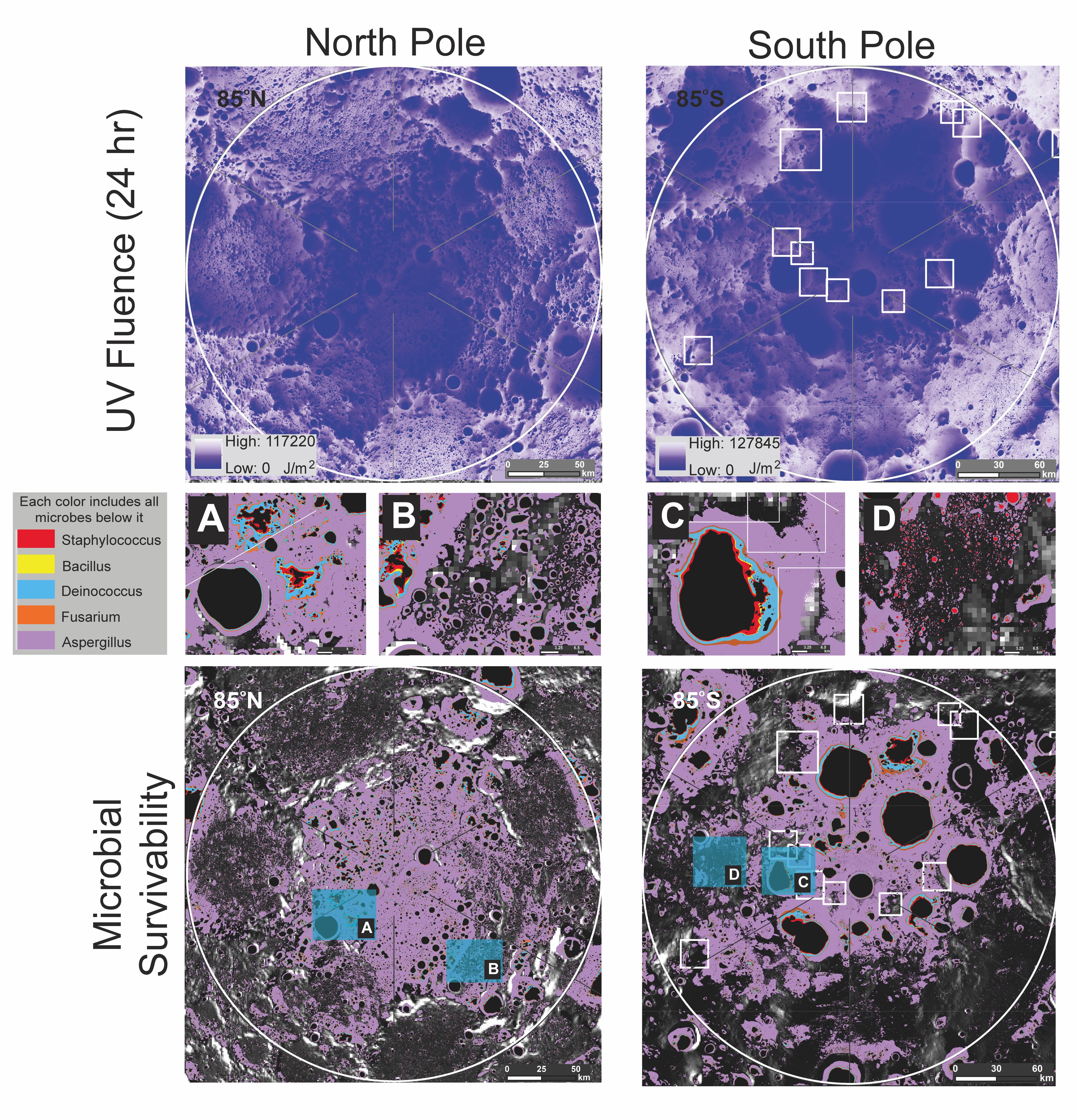
“When we created lunar maps with purple, red and blue representing different surviving microbe species, we were surprised at how colorfully they turned out,” said study co-author Stefano Bertone, an associate research scientist in the University of Maryland’s Department of Astronomy. “So much for ‘nothing can survive on the moon.’”
The paper’s findings highlight a need to better understand microbial persistence, which varies dramatically between organisms, in extreme lunar environments. As humans build a permanent presence on the moon and begin landing on Mars, it may become difficult to distinguish ancient chemistry from contamination astronauts leave behind.
Microbes are humans’ constant companions, and we shed them wherever we go. A patch of skin the size of a pinky nail may house a million bacteria, for example. That means in one small step, astronauts walking on the moon could leave hundreds of millions of live bacteria in their boot prints. And no matter how strict the sterilization procedures, “there’s potential for a lot of human contamination of the lunar landscape and, inevitably, the science we do there,” Bertone said.
Planning around that contamination, wherever astronauts go, is crucial.
“We need to understand what was there before us, because when we go to Mars to search for signs of life beyond our planet, we will want to make sure it’s not stuff we brought,” said Prabal Saxena, a planetary scientist at NASA’s Goddard Space Flight Center who led the new study.
To get a baseline of where and which microbes might survive, it helps to understand how sunlight behaves at the poles. Because the moon has a very small axial tilt, the sun appears to hover just above the horizon at its poles. As a result, even minimal elevation blocks light from reaching low-lying terrain, creating pockets of shadow that can stay cold, preserve water and block lethal radiation.
Previous studies have suggested a very low likelihood of microbial survival where humans have set foot on the moon—mainly in equatorial areas. But the model for those studies did not include the effects of topography, which can significantly affect conditions relevant to microbial survival, especially in lunar polar regions, which are currently of great interest for human exploration.
“Incorporating the bumps and craters was a key to this study,” Bertone said. “The question was, how well can the moon’s surface topography shield some areas from UV, and is it enough to keep any of our study organisms alive?”
The scientists tested microbes commonly found in spaceflight environments and/or on human skin in simulations of three regions near the lunar south pole that are landing site candidates for the upcoming Artemis III mission. The simulations used detailed environmental maps built from elevation and temperature data collected by instruments aboard NASA’s Lunar Reconnaissance Orbiter, combined with models of how radiation strikes the moon’s surface.
Specifically, Bertone used ray tracing, a technique for modeling light transport that can simulate a variety of optical effects including reflection, refraction, soft shadows and more, with data from the Lunar Orbiter Laser Altimeter—which provides precise topographical information including surface brightness, slopes and roughness.
“We can trace the path of light from the sun to the moon considering the sun’s position and every bump and boulder that causes a ray to bounce and pivot before reaching the surface,” he explained. “Even what are called permanently shaded regions get light, and therefore UV, indirectly. It’s all extremely nuanced, and this method lets us account for small details.”
The models showed maps of “survivable niches” in a range of sizes, with survival times of up to seven days. Notable findings included the extreme UV resilience of the Aspergillus fungus, which could potentially survive in 15 to 30% of areas receiving some sunlight during lunar winter. The reconstructions also showed that each microbe found survivable areas in all three regions—with Aspergillus persisting on 3% of the mapped landscape for at least seven days—and that all five microbes could potentially survive in portions of the De Gerlache Rim’s permanently shaded regions when scattered UV light is included.
Importantly, survival is not the same as growth, and surviving microbes are in a cryptobiotic state where growth would be possible only if habitable conditions develop. There is no evidence the moon has key ingredients to sustain growth and replication, including liquid water, which typically requires an atmosphere and moderate temperatures.
Still, survival is a precondition for growth and remains highly relevant to exploration and science, Bertone said.
The study’s authors also see potential for the moon as a natural laboratory. In shaded areas around the south pole, scientists could carefully test the real-life limits of microbial survival and how these organisms behave when placed in an environment that can’t easily be reproduced on Earth.
For next steps the researchers plan to use more detailed illumination models; higher-resolution topography via a technique called shape from shading, which can reconstruct 3D planetary terrain, craters and surface slopes from 2D photographs by analyzing light intensity, shadows and surface angles; and additional microbial studies to better understand the story of human-related microbes on the moon.
“In planning human operations to the moon or elsewhere, we need to know everything we can about what’s been left behind,” Bertone said.
***
This press release was adapted from text provided by NASA.
The paper, “Potential survivable niches for microbial life on the lunar south pole,” was published in Science Advances on August 19, 2026.
This work was supported by NASA (Award Nos. 24-PPR24-0003, 80GSFC24M0006 and 820GSFCS), the NASA Goddard Science Task Group Program and the GSFC Sellers Exoplanet Environments Collaboration. This article does not necessarily reflect the views of these organizations.