UMD astronomers glimpsed a massive star’s death from the first explosive moment, reporting their findings in a new study.
A rare cosmic explosion gave University of Maryland astronomers an unprecedented view of a massive star in its final moments, revealing a previously missing link between ordinary supernovae and the most energetic explosions in the universe.
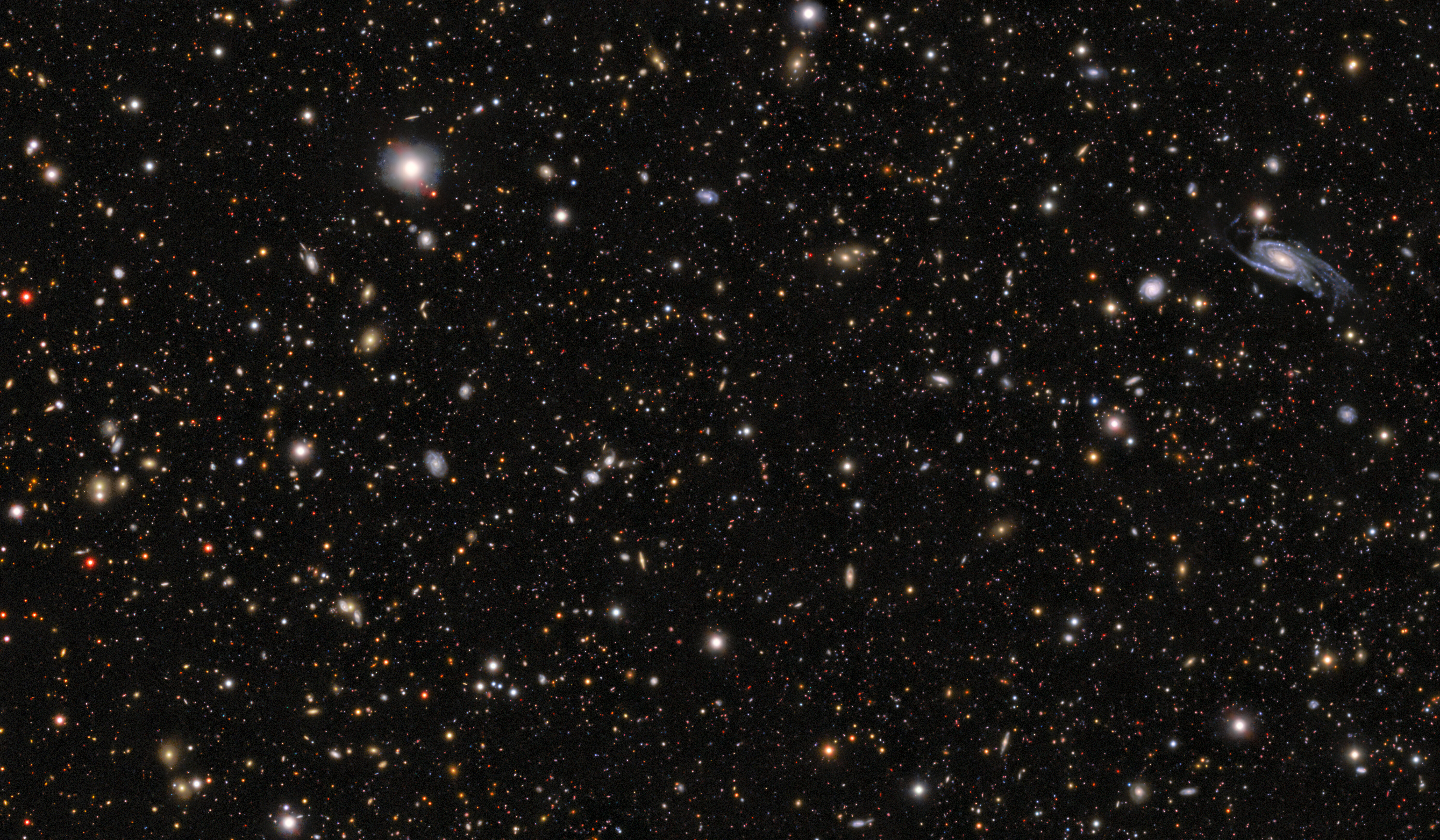
In March 2026, the Einstein Probe—a telescope mission led by the Chinese Academy of Sciences—detected a brief flash of soft X-rays emitted from a galaxy about 500 million light-years away. The flash—dubbed EP260321a—immediately triggered a global observing campaign. Within an hour, ground-based telescopes began monitoring the source, revealing a rapidly brightening supernova later designated SN 2026gzf.
A research team led by Jillian Rastinejad, a NASA Hubble Fellowship Program Einstein Fellow at UMD’s Department of Astronomy, observed the event and monitored its evolving light profile. They identified the initial burst of X-rays as a “shock breakout”—the moment when the powerful shock wave from a stellar explosion bursts through the star’s surface and releases the first light of a supernova. These phenomena last mere seconds to hours and are exceptionally rare to observe, with only one other shock breakout confidently identified in the past two decades. Rastinejad’s team published their latest discovery in The Astrophysical Journal Letters on August 5, 2026.
“Our observations allowed us to study the physics of three pieces of this explosion: the X-ray shock breakout, the accompanying supernova and the interaction of the supernova with material previously cast out by the dying star,” Rastinejad said. “With this information, we were able to map out the structure of the material surrounding the star and understand the star’s violent lifestyle before it collapsed.”
Using data from a variety of telescopes and observatories, Rastinejad and her team confirmed that the explosion belonged to a special class called Type Ic (Ic-BL) supernovae. Ic-BL supernovae typically possess jets of material moving close to the speed of light, called relativistic material, and are commonly linked to gamma-ray bursts—the brightest and most powerful explosions in the universe. However, unlike previously observed Ic-BL supernovae, the one observed in this study showed no evidence of relativistic jets or gamma-ray bursts.
Instead, the recent observations represented the faintest shock breakout ever associated with an Ic-BL supernova. The discovery that an Ic-BL supernova can lack a gamma-ray burst, relativistic material and a long-lived afterglow suggests that massive stars can die through a wider range of pathways than previously recognized.
Additionally, the researchers determined that the explosion stemmed from the death of a Wolf-Rayet star—a star born with about 20 times the mass of the Sun that burns through its hydrogen early in its life. In the lead-up to its explosive death, the star lost mass in irregular episodes, ejected all of its hydrogen and helium and left behind a stripped star made mostly of carbon and oxygen. This created multiple shells of material around the star: a nearby, compact shell of low-mass material that emitted the initial X-ray signal, plus an extended shell of material that emitted the supernova signal.
“This is the first time we’ve mapped out the pre-explosion environment of a star that has been stripped of hydrogen and helium,” said Gokul Srinivasaragavan (Ph.D ’26, astronomy), the study’s second author. “Going forward, I’m excited to observe more shock breakout events in similar detail to test if all stripped stars have a similar lifestyle prior to collapse and what, if any, differences we see.”
###
This press release was adapted from text provided by the U.S. National Science Foundation National Optical-Infrared Astronomy Research Laboratory.
UMD Astronomy Adjunct Professor Stephen Bradley Cenko and Neil Gehrels Prize Postdoctoral Fellow Robert Stein coauthored this article with Rastinejad and Srinivasaragavan.
The paper, “A Multi-Wavelength View of the First Type Ic-BL Supernova with an Einstein Probe X-ray Shock Breakout,” was published in The Astrophysical Journal Letters on August 5, 2026.
This research was supported by funding from NASA (Award Nos. HST-HF2-51587.001-A, NAS5-26555, 24-ADAP24-0159, HSTHF2-51558.001-A); the Kavli Foundation; the University of Toronto–Hebrew University of Jerusalem Research and Training Alliance program; the David Dunlap family; the University of Toronto; the David and Lucile Packard Foundation; the Research Corporation for Scientific Advancement; the U.S. National Science Foundation (Award Nos. AST-2433718, AST-2407922, AST-2406110, PHY-2117997, PHY-2308862, PHY-2409481, AST 2505775, AST-2401779, 2407588, 1106171, AST-1258333, AST-2241526, AST-1202910, 2211468); the Aramont Fellowship for Emerging Science Research; the LSST Discovery Alliance; the John Templeton Foundation (Award No. 62192); Stanford University; the U.S. Department of Energy (Award No. DE-AC02-76SF00515); the Research Corporation for Science Advancemen’s Scialog Award (Award No. SA-LSST-2024-102a); the Discovery Alliance Catalyst Fellowship Mentors award (Award No. 2025-62192-CM-19); the Alfred P. Sloan Foundation’s Sloan Research Fellowship (Award No. FG-2024-21320); DGAPA/PAPIIT (Award No. IN113424); the Knut and Alice Wallenberg Foundation’s “Gravity Meets Light” project; National Research Council (Canada); Agencia Nacional de Investigación y Desarrollo (Chile); Ministerio de Ciencia Tecnología e Innovación (Argentina); Ministério da Ciência, Tecnologia e Inovação (Brazil); the Korea Astronomy and Space Science Institute (Republic of Korea); and the UK Science and Technology Facilities Council.