
News
News
Filter by
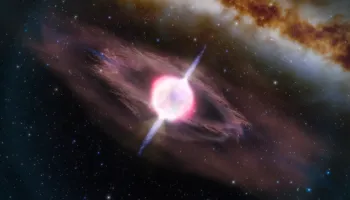
UMD Scientists Help Uncover Origins of Castaway Gamma-ray Bursts
These enigmatic bursts of energy have been traced back to previously undiscovered galaxies in the early Universe.

Congratulations to the almost 3,000 Spring 2022 semester Dean's List awardees from the University of Maryland College of Computer, Mathematical, and Natural Sciences.

UMD Named a Host Institution for Prestigious Planetary Science Postdoctoral Fellowship
Through the Heising-Simons Foundation’s 51 Pegasi b Fellowship, postdoctoral researchers will have the chance to probe the mysteries of the universe at the University of Maryland.
Congratulations to the College's May 2022 Graduates!
More than 1,600 students graduated from our college in May 2022.

Andrew Harris Reappointed as Chair of UMD’s Department of Astronomy for Five-year Term
Harris hired new faculty members, strengthened research ties with NASA and improved research facilities during his first term as chair.

UMD Astronomers on Team Selected by NASA for Moon Exploration Mission
The team will study a previously unexplored region that may hold clues to how the moon and other similar celestial bodies formed over time.

Take some time this summer to read the latest books from Science Terps.

Supernova Ph.D. Student Selected for NASA Pathways
UMD astronomy student Isiah Holt studies the composition of neutron stars

Richard Mushotzky Awarded 2022 Henry Norris Russell Lectureship by American Astronomical Society
The lectureship is awarded annually based on a lifetime of eminence in astronomical research.

More than 3,100 students were named to the University of Maryland College of Computer, Mathematical, and Natural Sciences Dean's List for Fall 2021.

UMD Astronomers Honored with American Astronomical Society High Energy Astrophysics Division Awards
Keith Arnaud and Brad Cenko received prizes for innovation and significant advances in the field.

Astronomers Trace Galaxy Flows Across 700 Million Light-Years
UMD-led study traces the movement of 10,000 galaxies and clusters of galaxies for 11.5 billion years.