
News
News
Filter by

UMD Rises in Global Scientific Productivity Rankings
The Nature Index 2015 Global ranks UMD No. 54 among the world's most productive scientific research institutions.

UMD Astronomers Celebrate ‘Deep Impact’ 10-Year Anniversary
Deep Impact and its subsequent investigations transformed our understanding of comets.
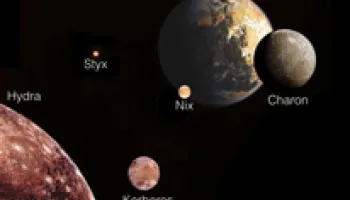
Pluto’s Moons Seen in Highest Detail Yet
A new study in the journal Nature is the first to reveal fascinating details about the orbital and rotational patterns of Pluto and its five known moons.

UMD Researcher Leads National Climate Indicators Project
Melissa Kenney, a research assistant professor in the Earth System Science Interdisciplinary Center, guided the vision and development of the indicators system.
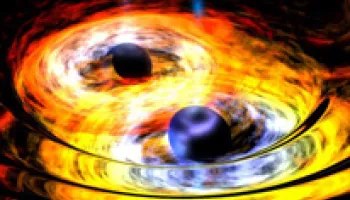
Pulsing Light May Indicate Supermassive Black Hole Merger
New study sheds light on end stages of mysterious gravitational dance.

Join Us for Maryland Day on Saturday, April 25th!
Science—whether physics, biology, chemistry or mathematics—is for everyone. Learn and explore this year at 35 CMNS Maryland Day events.
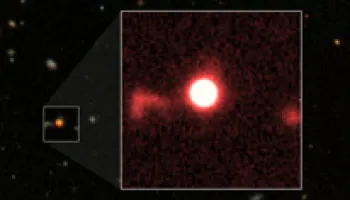
Supermassive Black Hole Clears Star-making Gas From Galaxy’s Core
A new study shows that a supermassive black hole removes massive quantities of star-making gas from its host galaxy, thus influencing the galaxy’s size, shape and overall fate.

Heads Up! You Can Help Build the Maryland All-Sky Camera Network
Crowdfunding campaign aims to bring all-sky cameras to the University of Maryland Observatory and Montgomery College Observatory.

Massive Amounts of Saharan Dust Fertilize the Amazon Rainforest
New study quantifies the connection between Earth's largest temperate desert and its largest tropical rainforest
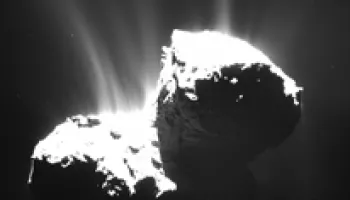
Rosetta Data Give Closest-ever Look at a Comet
Special issue of Science reveals details about shape, evolution and lifespan of comet 67P-Churyumov/Gerasimenko.

Astronomers Discover Unique Spiral Galaxy with Twin “Jets” and “Halo”
With the help of citizen scientists, a team that includes UMD astronomers has found an important new example of a very rare type of galaxy that may yield valuable insight on how galaxies developed in the early universe.
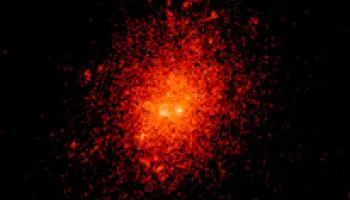
Dwarf Galaxy Mystery: ‘Kicked’ Black Hole or Mega Star?
An unusual source of light in a galaxy some 90 million light-years away has been discovered by an international team that includes UMD astronomy researchers and an alumnus.