Sylvain Veilleux and his collaborators will equip a ground-based telescope with the observing power of space telescopes for the first time.
For decades, astronomers have faced an invisible obstacle: the glow of Earth’s own atmosphere.

When scientists try to observe faint, distant celestial objects in infrared light, the sky itself lights up—not just from city lights or clouds, but from a chemical reaction happening miles above Earth’s surface. When sunlight breaks ozone apart in the upper atmosphere in the presence of water, OH molecules are produced and emit a dense barrage of light. The light from OH often completely drowns out the faint signals astronomers are trying to detect from the ground with infrared detectors.
University of Maryland Astronomy Professor Sylvain Veilleux was awarded a four-year, $2.5 million grant from the Gordon and Betty Moore Foundation to build an instrument that can solve that problem.
The instrument, called the Maryland OH Suppression Infrared System (MOHSIS), will be installed on the 4.3-meter Lowell Discovery Telescope (LDT) located in Arizona. Using advanced photonic fiber technology, MOHSIS will filter out OH-caused atmospheric glow before it ever reaches the main instrument, leaving behind only the faint light astronomers want to study.
“Basically, what we’re doing is like putting a ground-based telescope in space—just without putting it in space,” Veilleux explained. “With MOHSIS, any large ground-based telescope can see what a space telescope like the James Webb Space Telescope sees. We save time, money, effort and resources by using MOHSIS to boost our ground telescopes instead of launching a new telescope up into space.”
Veilleux said that the idea of attaching advanced filters to ground-based telescopes originated over 10 years ago through his long-term collaboration with researchers from the University of Sydney and Macquarie University in Australia.
“An earlier version of MOHSIS was tested at an Australian facility, and that work now lays the groundwork for what MOHSIS will attempt on a much larger scale,” Veilleux noted. “With this support from the Moore Foundation, we can take it to the next level.”
MOHSIS is essentially a filter, but not like the kind on a conventional camera lens. Instead, it’s built from optical fibers, each no wider than a human hair, which have been precisely modified at the microscopic level.
“As light from a distant galaxy travels into the LDT, it will first pass through MOHSIS. The fiber will bounce the atmospheric interference back out while allowing faint galaxy light to continue through,” Veilleux explained. “That cleaned-up signal will then enter a companion instrument we developed, called the Rapid infrared IMAger Spectrometer, which will spread the light into a spectrum that scientists can analyze.”
MOHSIS will simultaneously suppress roughly 200 individual “lines” of atmospheric interference—making the brightest ones 10,000 times less intense. The result is a much cleaner view than any ground-based telescope has previously achieved in this range of light. With MOHSIS and RIMAS working together, the Lowell Discovery Telescope will gain observing power previously achievable only from space.
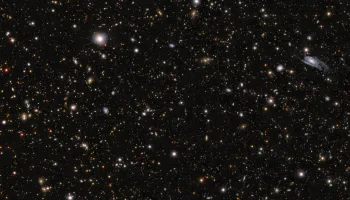
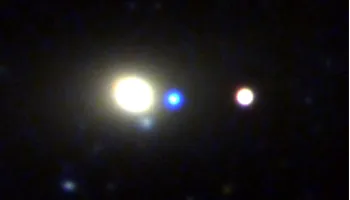
Veilleux and his team plan to use MOHSIS to study some of the most distant galaxies ever observed—tiny, young dwarf galaxies that were forming just a few hundred million years after the Big Bang, when the universe was still in its infancy. To find them, the researchers will rely on gamma-ray bursts.
Extraordinarily bright and short-lived explosions, gamma-ray bursts are among the most powerful events in the universe. A burst can be up to 100 million times brighter than the galaxy it originated from, acting like a flashlight to illuminate surrounding material. By taking a spectrum of that light, researchers can learn what the host galaxy is made of, how it’s moving and how early galaxies built up from the elements that would eventually form stars and planets.
“MOHSIS will be a real game changer,” Veilleux said. “We’ll prioritize data from NASA’s [Neil Gehrels] Swift Observatory, which detects these bursts in real time, and the Lowell Discovery Telescope is well-suited to respond quickly, so we can identify and swing to the target within minutes of an alert from Swift.”
Veilleux sees MOHSIS as just the beginning. The Moore Foundation grant will fund student researchers and a postdoctoral associate who will build and test components at Goddard and travel to Australia to collaborate with the team’s partners. Once MOHSIS is commissioned, access to the instrument will be opened to the broader astronomy community with access to the Lowell Discovery Telescope. And if the technology succeeds on a 4.3-meter telescope like Lowell’s, the next step would be scaling it to 10- and 30-meter-class telescopes now being planned around the world. Veilleux said the impact of that would be transformative.
“All telescopes that work in the near-infrared should have these filters,” he said. “With them, we can see what we’ve been looking for more clearly than ever.”
###
Other UMD researchers supported by the Moore Foundation grant include postdoctoral associate Joseph Durbak (Ph.D. '25, physics), astronomy graduate student Jane Heathcote, associate research scientist Alexander Kutyrev, incoming astronomy graduate student Jeremy Lin, and senior astronomy and physics double major Matthew Prem.